It’s back to directing this month with Eugene A. Melino’s play Son of Anarchy, selected for the Queens Short Play Festival. These festivals are a sprint and the cast came ready to play. They have brought so much love and humanity to this multi-layered text. It’s amazing what can happen in 13 minutes. Read more about the production here.
The Secret Theatre is two blocks away from the 7 train’s Woodside-61st St station at 38-02 61st St. Our festival performances are February 22, February 28 and March 5 all at 7:30PM; and a matinee performance on March 12 at 3:00PM.Get your tickets for Program B here.
It’s been a year since our lives moved into our homes, and in this blog Desirée examines the reality with which both Hedgepig as a company and as artists have had to come to grips.
This month we move the spotlight to one of our extraordinary ensemble members, Desirée Baxter.
It’s been a year since our lives moved into our homes, and in this blog Desirée examines the reality with which both Hedgepig as a company and artists as whole have had to come to grips.
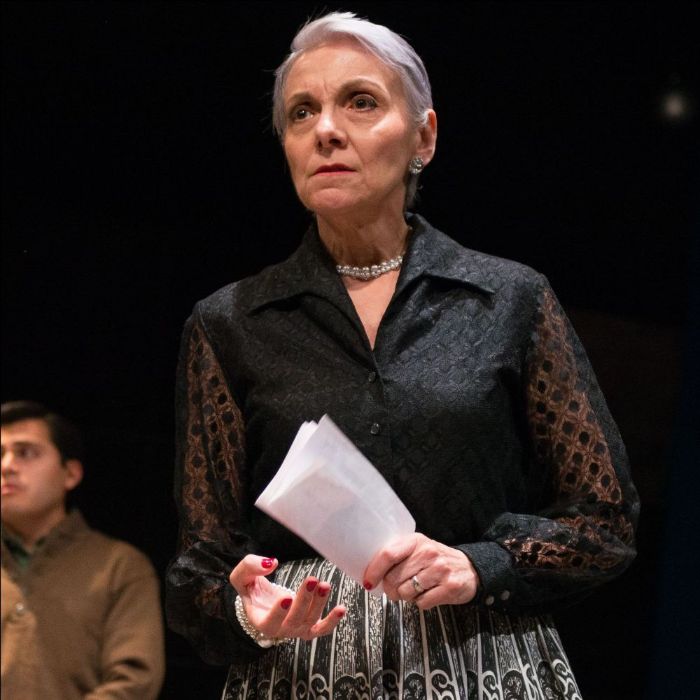
Desirée Baxter in Hedgepig’s 2018 production of All’s Well That Ends Well
“Plans and Provisions”
Amanda: …the future becomes the present, the present the past, and the past turns into everlasting regret if you don’t plan for it! – The Glass Menagerie, scene five
As the “pause” approaches the one-year mark, theatre-makers find themselves yearning for the good old days and eager to get back to normal. We are nostalgic for those decrepit black boxes where we valiantly launched our latest creative endeavor. But like Noah emerging from the ark, we have no idea what we’ll find when we pop the hatch and step on dry ground.
When Nostalgia Was a Disease
The word “nostalgia” was coined to describe a form of mental illness, from the Greek nostos (homecoming) and algos (ache or pain.) It was first described as a psychological disorder in the 17th century among Swiss mercenaries fighting in foreign wars. It was a debilitating form of melancholia. Sailors and soldiers displayed symptoms ranging from headaches and loss of appetite to fevers and death (not unlike pandemic-induced depression.) Treatment could be anything from a ration of wine (homeopathic) to being buried neck-deep and taunted (middle school nightmare.)
Apparently, nostalgia is a coping mechanism used since ancient times. Odysseus dealt with battle fatigue by reminiscing about his wife and children. Pleasant memories of the past can make a dismal, seemingly unending present tolerable. But it can become a pathology when it romanticizes the past. If the Black Lives Matter movement has taught us anything, it is that a nostalgic reading of history comes at our peril.
We made some great theatre in the old days but need I bury you up to the neck in sand and remind you of the holding rooms where we sat on the floor for hours, waiting to do two contrasting monologues (total audition time not to exceed 2 minutes please!) Or the freezing/sweltering rehearsal halls that “smell funny” and have a support pillar where center stage should be. Or the black boxes that were last cleaned during the Clinton administration, and were graciously accommodated with a single working toilet for the cast, crew AND audience. Or, in my case, moving from space to space dragging my office, closet, salon and library behind me in a rolling backpack I dubbed the “dead pig.”
“You’re on Mute”
We have spent the last twelve months learning new skills, new software and testing the limits of technology. We’ve all become improv artists because a pandemic, broadband, climate change and American politics have taught us that anything can happen. But we’ve persevered and discovered new techniques and new audiences.
Past: A year ago Hedgepig was an ensemble based in Brooklyn, drawing an audience primarily from the five boroughs.
Present: Thanks to “Expand the Canon” and our search and advocacy for classic plays by women, we have fans nationwide.
Future: How will we embrace our actual and virtual audiences, individually and collectively and thrive?
Now the question arises – how do we make the “plans and provisions” Amanda Wingfield suggests? I certainly don’t want to abandon that far-flung virtual audience and I don’t want to endanger the health of the local actual audience in a cramped, improperly ventilated performance space. Now I need a hybrid. What do I jettison?
What do I add to my virtual and actual rolling “dead pig?”
Eat-in or Take-out?
There is nothing as magical as creating live theatre for people sharing your physical location. The gasp or the giggle, the shifting in the seat or the stillness changes the molecules in the room. How do we give the virtual audience an actual experience?
But there is a democracy in Zoom. All the boxes are equal in size. It is two-dimensional, which means there is no foreground or background. And unlike film, the viewer rather than an editor decides whether to focus on the speaker or the listener from moment to moment. How do we stage live theatre to give that power to our actual audience?
The actual audience enters a space the ensemble has created. But the formula is reversed with a virtual audience– the ensemble enters their space. It’s the difference between sit-down dining and delivery.
Finally, actors have adapted to the limitations of Zoom by learning to live inside the “box.” And because the platform prevents cross-talking, we have learned to listen and respond more deliberately in our performances. How will these techniques continue to influence our acting choices actually and virtually?
Betting on an unseen future is risky, exhilarating and inevitable. In this never-ending present, I will keep imagining the new landscapes we might encounter as we venture back into the world – with plenty of plans and provisions stuffed in my rolling “dead pig.”
I am, for the present, virtually yours, Desirée
And Yet We Persist…
That’s all for this month! Thank you so much to Desirée for the heartfelt reflection on a bewildering twelve months. Stay tuned for exciting news and developments from Hedgepig as we count down to our second year of Expand the Canon. In fact, in the next few weeks, our Expand the Canon reading committee members will be doing Instagram takeovers! If you don’t already, follow us at @hedgepigensembletheatre for behind-the-scenes play reading fun.
It has been a labor of love to bring this new adaptation of the beloved novel to life. Under the leadership of our fearless director, Brooke Viegut,Hedgepig Ensemble has created a funny and touching holiday charmer. The South Oxford Space in Fort Green, Brooklyn has been transformed into the March family home and it is stunning. Grab a Christmas cookie and eggnog then make yourself at home.
I am playing Marmee, shepherding these little women to adulthood. And I will let you in on a secret: This 19th century matriarch, alone in time of war, has a lot to teach us about 21st century parenting. Marmee understands that it is not her responsibility to protect her children from the world but rather to prepare them for it.
I call myself an actor-singer-director and I find the helix is the best metaphor to explain my life as an artist.
The Ascending Helix
Take it from the Silver Hedgepig, the conversation with distance relatives and non-artist acquaintances is always the same:
– “What are you working on?”
– Upbeat elevator pitch of your latest endeavor.
– “Oh, don’t you act/sing/direct anymore?” (Smugness optional)
– “Yes, but not today.”
Multitasking is a myth – artists choose one project as their priority. When I am engaged in a play, I put my other skills on the back burner until I need them. But even as I return to a particular aspect of artistic expression, I am keenly aware that my work in other disciplines has moved me higher on a spiral. My acting informs my singing which informs my directing which informs my acting.
“To turn, turn will be our delight,
Till by turning, turning we come round right.”
–Simple Gifts by Joseph Brackett (1797-1882)
The helix also explains why I wanted to be a Hedgepig. Our ensemble is the scaffolding essential to my helix. Our monthly trainings bring us together as knowledgeable peers with unique techniques and tools to create scaffolding. That is, the safe space bridging the gap between what we can achieve independently and what we can achieve with the guidance, motivation and encouragement of skilled collaborators. And believe me they are highly skilled.
But when I was an undergrad, the helix was the bane of my existence. My artistic education was based on Dr. Ronald B Thomas’ pedagogical study of psychologist Jerome Bruner’s theory of spiral – or as we called it – helix learning.
The Despised Comprehensive Musicianship Spiral
The aim was to make us autonomous lifelong learners and creators. This involved structuring information so that complex ideas can be taught at a simplified level first, and then re-visited at more complex levels later. We were required to compose, perform and evaluate music. We would organize our knowledge by “discovering” our own unique coding system rather than one offered us by an instructor. Ideally, this would enable us to become independent problem-solvers.
Teachers were to provide the information required for a project but not to organize it for us. Their role was to provide “scaffolding,” helpful, structured interaction to simplify the task by: a) offering models to imitate, b) highlighting important elements or errors, and c) encouraging students. I needed lots of encouragement.
Helix learning was intended to take students from diverse backgrounds and give them an individual learning experience. Unfortunately, this idyllic ever-rising spiral was at odds with a university evaluation system and conservatory performance standard that were both rigidly linear. The kid who had been chained to a musical instrument since age five and gone to schools offering advanced music theory consistently got the highest marks and the best opportunities. I was working class kid who, armed only with a big, pretty mezzo voice and the ability to learn harmonic vocal lines quickly, launched myself into the music education program at Virginia Commonwealth University. For me, the helix bore a striking resemblance to chasing my tail at best, or a maelstrom at worst. I graduated with many “experiences” but without a “coding” system I could articulate to others. Yet I always had work. Not always the most musically or economically satisfying but I worked.
My career never was nor ever will be linear. With Hedgepig Ensemble’s scaffolding, I keep ascending the spiral. And that gives me joy. Congratulations Drs. Thomas and Bruner, I am a livelong learner and creator. Every new project presents an opportunity for me to offer my best tools and to beg, borrow or steal the best of my colleagues.
Theater 2020’s production of Marc Blitzstein’s “The Cradle Will Rock” opens June 7 and runs to June 30. I am having so much fun playing both Dauber, the painter and Professor Mamie. How often do you have an opportunity to play both satire and clown?
This piece of musical theatre history is painfully relevant 72 years later. There are some talented folks in this company and it is wonderful to be on stage with them. Head to Brooklyn and check it out.
Last weekend, I became a full member with Hedgepig Ensemble Theatre. The company has been on my radar since I auditioned for their production of “Merry Wives” in 2015. Since then I’ve attended performances, events, trivia nights and gotten to know folks. I very much wanted to be a part of an ensemble company and Hedgepig was a great fit. The commitment to elevating women’s voices and investing in the growth of all company members really drew me in. Add reimagining classic works, and I was hooked.
After auditioning for the ensemble last June, I was offered “Fledgepig” status and attended company trainings and the ensemble retreat at Harriman State Park. An offer to play Countess Roussillon in “All’s Well That Ends Well” followed and we opened at the Gene Frankel Theater downtown in December. It was a terrific show, directed by Emily Lyon, with a talented, diverse cast. I was confident that I had found my tribe.
So 2019 brought with it full member status, some administrative responsibilities and the obligatory t-shirt. I guess my waffle making skills at Waffle-Palooza outweighed my inability to boil water for pasta on a campsite hot plate…
Hmmm, I may have stumbled upon some business for the company’s clowning workshops at the end of the month!
It’s official I’m a “Fledgepig” with Hedgepig Ensemble Theatre! I have just returned from a weekend retreat with the company in Harriman State Park. A lovely holiday weekend of fellowship, improvisation (and not just at meal preparation) and ensemble building. Invigorated and insect-bitten.
I am excited to be working with dell’Arte Opera Ensemble as co-director for “Vignettes from Vienna” staging scenes from Mozart’s “Così fan Tutte” and “Le Nozze di Figaro.” I will also be assisting stage director Brittany Goodwin in the American Premiere of Salieri’s “La Cifra.” Both productions will be at the Tony award winning La MaMa.
“La Cifra” performances are August 18, 22, 24 and 26.
“Vignettes from Vienna” plays August 20 and 21. Check out dellarteopera.org for the full festival schedule.
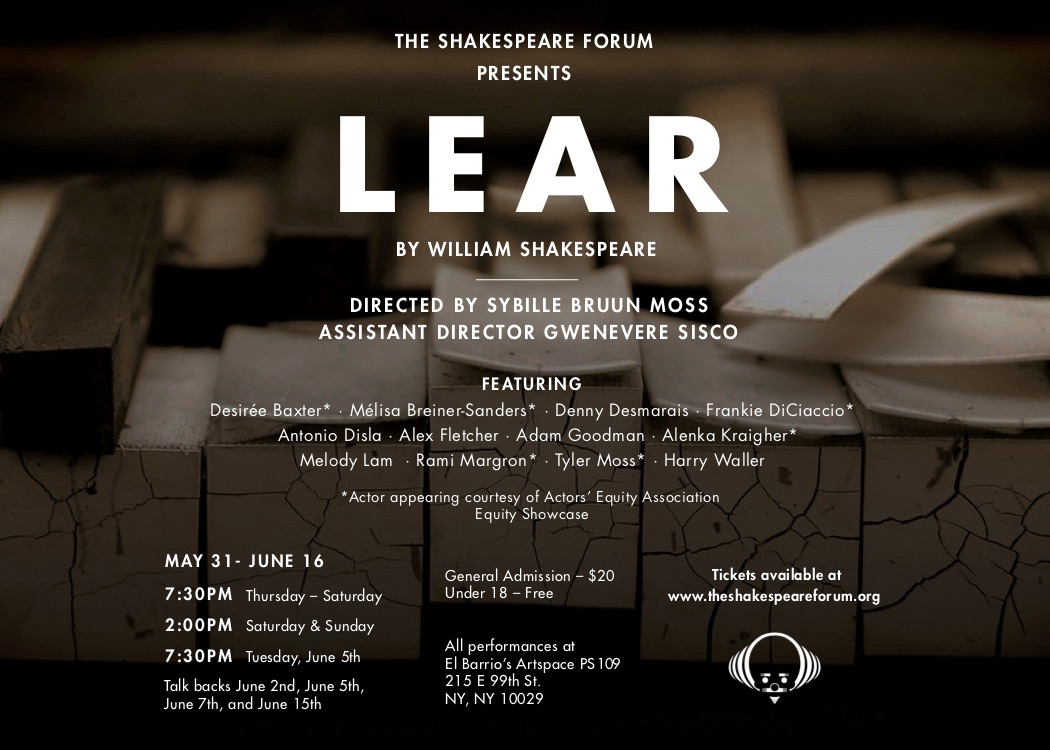
I am delighted to be a part of THE SHAKESPEARE FORUM’s production of LEAR. There are 16 performances between May 31 and June 16 as part of the El Barrio Shakespeare Festival. The theater is located on 99th Street between 2nd and 3rd Avenues in Manhattan. The festival boasts three weeks of workshops and performance in a vibrant neighborhood. Check it out at http://www.theshakespeareforum.org/summer-festival







 I’d love to see you there!
 Desirée Baxter