
Reposted from “The Secret Life of Pigs” Hedgepig Ensemble Theatre’s Sept 2019 blog.
I call myself an actor-singer-director and I find the helix is the best metaphor to explain my life as an artist.

Take it from the Silver Hedgepig, the conversation with distance relatives and non-artist acquaintances is always the same:
– “What are you working on?”
– Upbeat elevator pitch of your latest endeavor.
– “Oh, don’t you act/sing/direct anymore?” (Smugness optional)
– “Yes, but not today.”
Multitasking is a myth – artists choose one project as their priority. When I am engaged in a play, I put my other skills on the back burner until I need them. But even as I return to a particular aspect of artistic expression, I am keenly aware that my work in other disciplines has moved me higher on a spiral. My acting informs my singing which informs my directing which informs my acting.
“To turn, turn will be our delight,
Till by turning, turning we come round right.”
–Simple Gifts by Joseph Brackett (1797-1882)
The helix also explains why I wanted to be a Hedgepig. Our ensemble is the scaffolding essential to my helix. Our monthly trainings bring us together as knowledgeable peers with unique techniques and tools to create scaffolding. That is, the safe space bridging the gap between what we can achieve independently and what we can achieve with the guidance, motivation and encouragement of skilled collaborators. And believe me they are highly skilled.
But when I was an undergrad, the helix was the bane of my existence. My artistic education was based on Dr. Ronald B Thomas’ pedagogical study of psychologist Jerome Bruner’s theory of spiral – or as we called it – helix learning.
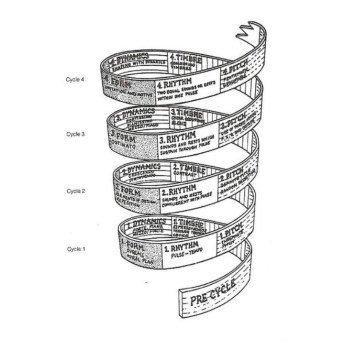
The aim was to make us autonomous lifelong learners and creators. This involved structuring information so that complex ideas can be taught at a simplified level first, and then re-visited at more complex levels later. We were required to compose, perform and evaluate music. We would organize our knowledge by “discovering” our own unique coding system rather than one offered us by an instructor. Ideally, this would enable us to become independent problem-solvers.
Teachers were to provide the information required for a project but not to organize it for us. Their role was to provide “scaffolding,” helpful, structured interaction to simplify the task by: a) offering models to imitate, b) highlighting important elements or errors, and c) encouraging students. I needed lots of encouragement.
Helix learning was intended to take students from diverse backgrounds and give them an individual learning experience. Unfortunately, this idyllic ever-rising spiral was at odds with a university evaluation system and conservatory performance standard that were both rigidly linear. The kid who had been chained to a musical instrument since age five and gone to schools offering advanced music theory consistently got the highest marks and the best opportunities. I was working class kid who, armed only with a big, pretty mezzo voice and the ability to learn harmonic vocal lines quickly, launched myself into the music education program at Virginia Commonwealth University. For me, the helix bore a striking resemblance to chasing my tail at best, or a maelstrom at worst. I graduated with many “experiences” but without a “coding” system I could articulate to others. Yet I always had work. Not always the most musically or economically satisfying but I worked.
My career never was nor ever will be linear. With Hedgepig Ensemble’s scaffolding, I keep ascending the spiral. And that gives me joy. Congratulations Drs. Thomas and Bruner, I am a livelong learner and creator. Every new project presents an opportunity for me to offer my best tools and to beg, borrow or steal the best of my colleagues.
 Desirée Baxter